- Jan 10
You Were Never the Problem: Why Learning Piano Felt Hard (And How It Can Become Simple)
Most adults who want to learn piano don’t struggle because they’re incapable.
They struggle because they were taught to memorize instead of orient.
That distinction changes everything.
After more than 23 years of teaching piano and music theory to children, adults, and neurodivergent learners, I see the same pattern over and over: adults internalize early frustration as personal failure. They assume they’re “not musical,” “too old,” or simply not wired for music.
In reality, what most people were missing was not talent, motivation, or intelligence.
They were missing a clear system.
Adults Don’t Struggle Because They’re Bad Learners
Adults are excellent learners in most areas of life. They understand systems, patterns, cause and effect, and long-term skill building. When music feels confusing or chaotic, that disconnect often turns inward. People assume something must be wrong with them.
Sometimes this comes from childhood lessons that focused heavily on rote memorization without explanation. Sometimes it comes from inconsistent instruction or moving too quickly without a foundation. Either way, the result is the same: uncertainty becomes identity.
But learning difficulty is not the same as personal deficiency.
Instruction matters far more than talent.
When people are given a logical framework for how music works, confidence often returns very quickly.
The Musical Staff Is a Map, Not a Vocabulary Test
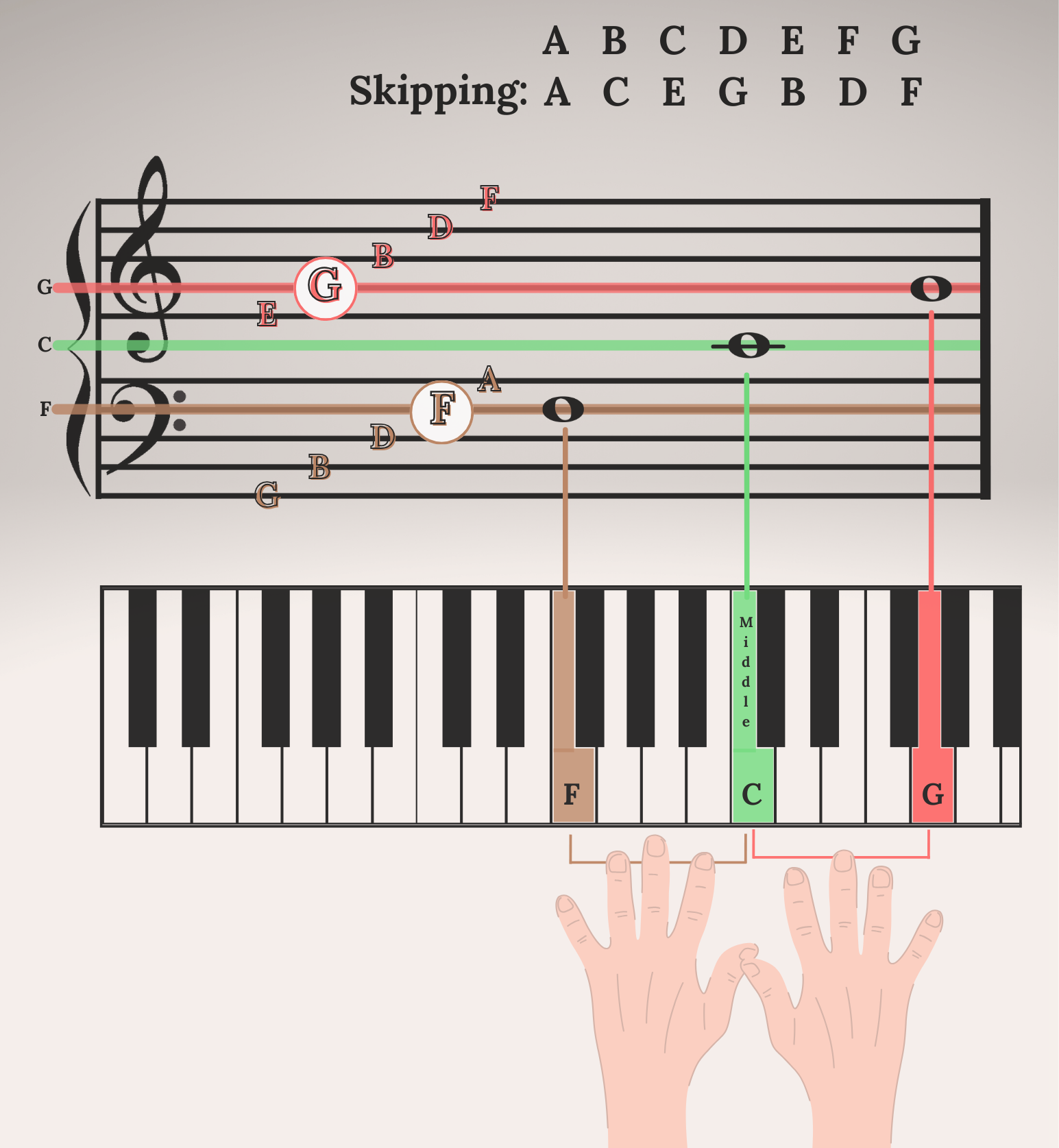
One of the biggest misunderstandings in early music education is treating the staff as something to memorize rather than something to navigate.
Mnemonic devices like “Every Good Boy Deserves Fudge” can temporarily help identify individual notes, but they add unnecessary cognitive steps. Students must remember the phrase, translate it into a letter, then locate the note on the instrument. That is a lot of mental overhead for something that should feel intuitive.
When students understand that the staff is actually a map of the instrument, everything settles. The clefs show orientation. Notes represent spatial relationships. Movement on the page corresponds to movement on the keyboard.
Instead of memorizing isolated symbols, students learn how to locate themselves and move intelligently. Reading becomes navigation, not decoding.
Confident Readers Don’t Think Faster, They Think Less
Strong readers are not mentally sprinting through dozens of note calculations. They have reduced the number of decisions their brain must make.
They think in:
Direction: up, down, repeating
Relationships: steps, skips, patterns
Groups: shapes, intervals, familiar chunks
This drastically reduces cognitive load and allows the brain to stay relaxed and accurate. Speed emerges naturally from clarity, not from forcing tempo.
This is not a shortcut. It is simply efficient design.
Reading Music and Playing by Ear Are Not Opposites
A common myth is that musicians must choose between reading music and playing by ear. In reality, these skills reinforce each other.
Strong readers begin to hear what they see on the page.
Strong ear players begin to visualize what they hear internally.
This integration builds musical fluency. It strengthens memory, phrasing, prediction, and expressive control. When developed together, these skills accelerate learning instead of competing for attention.
Musicianship grows best when the brain is allowed to connect sensory systems rather than isolate them.
A Student Story
One of my newer adult students shared that she took piano lessons as a child and felt consistently behind. Her sister progressed faster, which reinforced the belief that she simply wasn’t smart enough for piano.
In reality, her sister likely processed information differently and happened to adapt more easily to less structured instruction. My student needed clearer logic and orientation.
In her second lesson with me, her jaw literally dropped when she realized how simple the material could feel when explained logically. The confusion she had carried for years dissolved almost immediately.
She is now moving confidently through her book and rebuilding her relationship with learning.
The ability was always there. The system was missing.
When Learning Has Structure, Confidence Returns
If you’ve always wanted to learn piano but felt intimidated, overwhelmed, or discouraged, you are not broken. You are not late. You are not incapable.
If this way of thinking resonates with you, you may be someone who learns best through systems and clarity rather than memorization and guesswork.
I’m passionate about how we teach, not just what we teach, because access to good instruction changes how people see themselves as learners. When students have orientation, logic, and supportive structure, learning becomes energizing instead of defeating.