- Tuesday
Online Music Lessons Can Work Exceptionally Well, But You Have to Teach for the Medium
- Amanda
- Teaching Philosophy, Learning Theory, Creativity and Learning
- 0 comments
I’ve taught music for a long time, and a few criticisms of online lessons come up again and again:
"You can’t physically reposition a student’s hands," "You can’t play simultaneously because of latency," "You can’t easily count or tap along while the student is playing."
All of those things are true.
What I disagree with is the conclusion that sometimes follows: therefore, online music lessons cannot provide the same quality of instruction as in-person lessons.
That assumes those particular teacher actions are what make instruction effective in the first place.
I don’t think they are.
✨✨✨ ✨✨✨
You can’t teach online exactly the way you teach in person
Or, at least, you probably shouldn’t.
Online teaching has real limitations. There is latency. Camera angles can be annoying. Sound quality depends on equipment and settings. You cannot reach through the screen and physically move a student’s hand. Sometimes technology simply decides that today is going to be interesting.
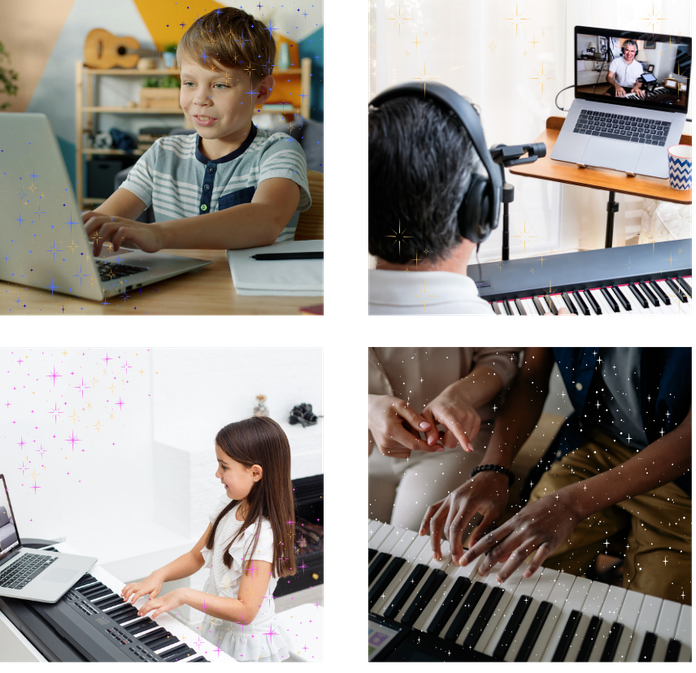
But good teaching isn’t about reproducing a particular set of teacher behaviours.
It’s about asking:
What am I trying to teach this student, and what experience will help them learn it?
If a teaching technique doesn’t work through a screen, the next question shouldn’t automatically be, “How can I imitate this online?”
Sometimes the better question is:
“What was I trying to accomplish by doing that, and is there another way to accomplish it?”
That distinction completely changed the way I thought about online teaching.
I was accidentally prepared for online teaching
Long before I ever expected to teach through a screen, I already tried to make my students do as much as possible for themselves.
If a student’s hand position needed to change, I generally didn’t physically put their hand into the position I wanted.
I showed them. I described it. I helped them notice what their hand was doing. I asked them to change it.
Why?
Because I’m not going home with them. After a few years of teaching, something became very clear to me: I only had about 30 minutes with each student every week. For the rest of their musical lives, they were on their own. I couldn’t build a teaching approach that depended on me being beside them. I needed to give them the tools to listen, think, problem-solve, and make musical decisions for themselves.
If their technique only works while I am physically arranging their body at the piano, what happens during the other six days of the week?
The same is true of rhythm.I rarely count for a student while they play. Instead, I guide them through a structured process of learning to feel the underlying beat, understand how the rhythm fits within that beat, and develop a counting system that makes those relationships clear. I provide the framework, demonstrations, and feedback, but the student does the counting. The goal is not for them to stay in time because I am supplying the pulse; it is for them to develop an internal sense of pulse they can rely on without me.
If they cannot maintain a steady beat or coordinate counting with their playing, I would rather stop and work on the underlying skill than temporarily solve the problem by supplying the pulse myself.
Again, I’m not going home with them.
The goal is not:
Can this student play successfully while I am sitting beside them?
The goal is:
Can this student increasingly understand, hear, diagnose, and solve musical problems independently?
When I began teaching online, that philosophy turned out to be extremely useful.
Latency is a problem. So solve the teaching problem.
One of the most commonly cited limitations of online music lessons is latency. Two people cannot reliably play together over ordinary video conferencing because the sound travelling in both directions creates a delay.
For me, however, this required surprisingly little adjustment because playing simultaneously with my students had never been a major part of my teaching. My role was to teach the student how to play, not to play alongside them. I would demonstrate a passage, isolate a problem, model a movement or sound, listen to the student try it, and then guide them through whatever needed to change. That same process translated quite naturally online.
When playing together did serve a specific purpose, I simply needed another way to accomplish that purpose. Accompaniments and duet parts could be recorded, for example, giving students something they could practice with repeatedly between lessons. The limitation was real, but it rarely interfered with the actual work of teaching.
This became a recurring lesson for me in online teaching: a technical limitation only becomes a teaching limitation when it prevents the student from developing the skill you are trying to teach.
If we’re working on rhythm, I can demonstrate first and have them respond. If something I normally do in person doesn’t work online, I ask what musical skill I was actually trying to develop and find another route to it.
Eventually, latency stopped being a significant issue in my everyday teaching. The technology didn’t change. My teaching did.
Sometimes the limitations are actually useful
This was the part I didn’t expect. Online teaching sometimes forces students to become more independent; I cannot reach over and fix something for them, so they have to learn how to fix it.
I cannot constantly manage everything happening at the student’s piano, so they have to take greater responsibility for managing it themselves. I cannot casually reach over and point to a spot on the page, so I developed other ways to communicate exactly where I need them to be. I can share my screen, refer to bar numbers, demonstrate the passage, or find another point of reference that makes sense to the student. There is rarely only one way to communicate or teach something.
Many of the apparent obstacles in online teaching are simply problems that require a different solution. Sometimes finding that solution requires creativity from me; sometimes it requires creativity from the student. Often, it requires both.
That process itself can be valuable: instead of depending on the teacher to manage every detail of the lesson environment, the student becomes an active participant in figuring out how to make the lesson work.
That is worth thinking about.

Good online teaching requires adaptation
I don’t think online lessons are inherently better than in-person lessons; I also don’t think in-person lessons are inherently better than online lessons. They are different environments with different strengths and limitations.
Some students will thrive online. Some will benefit significantly from being physically in the same room as their teacher. Some musical activities translate beautifully through a screen, while others require adaptation or simply cannot be fully replicated.
The useful question isn’t: “Which kind of lesson is superior?”
It’s: “Under what conditions can this student learn successfully in this environment?”
A teacher whose entire approach depends heavily on physically repositioning students, playing simultaneously with them, supplying their pulse, pointing to their music, or otherwise providing constant hands-on support may find online teaching extremely frustrating.
That doesn’t prove online teaching is ineffective.
It demonstrates that their particular teaching approach does not transfer easily to the online environment.
Those are not the same claim.
The teacher shouldn’t be indispensable
Ultimately, one of my biggest goals as a teacher is to make myself progressively less necessary.
I want students to know how to listen critically. I want them to notice when something doesn’t sound right. I want them to understand what they’re doing rather than simply follow my instructions. I want them to know how to break a difficult problem into manageable pieces. I want them to feel a pulse without me supplying it. I want them to recognize inefficient movement and know how to experiment with changing it. I want them to know what to do when they get stuck.
Because eventually, I won’t be sitting beside them.
And whether there are three feet or three hundred kilometres between us during the lesson, the music ultimately has to belong to the student.
That is what successful teaching looks like to me.
Online teaching certainly has limitations but sometimes those limitations force us to confront a much more interesting question:
How much of our students’ musicianship are we teaching them to do for themselves, and how much are we unknowingly doing for them?